About Greenland: Interview with Niels Henrik Hooge
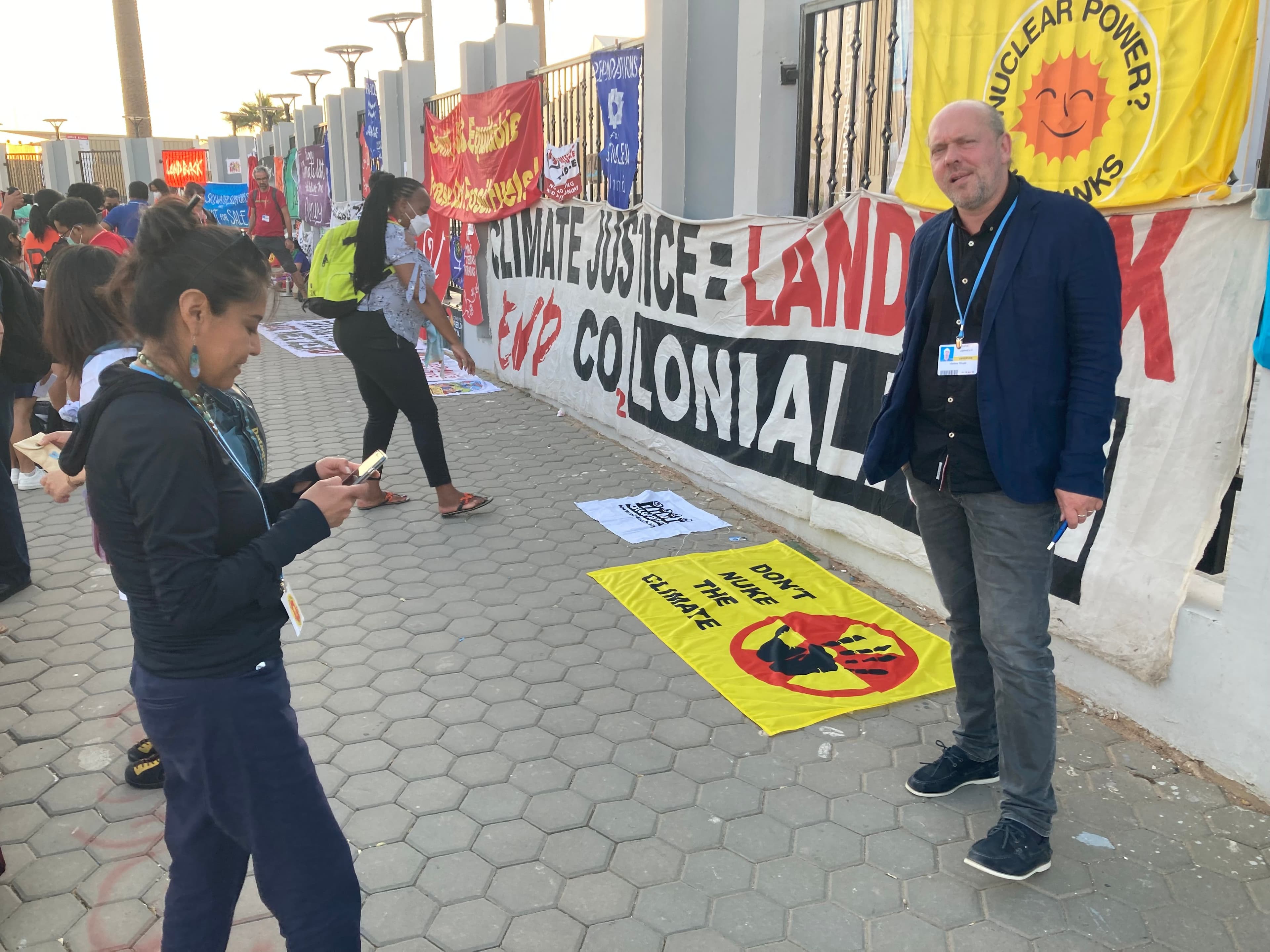
Niels Henrik Hooge is working with NOAH, the Danish branch of Friends of the Earth. He is also closely associated with Greenland's No to Uranium Association in Nuuk, URANI? NAAMIK. IPPNW Germany’s policy advisor on energy and climate, Patrick Schukalla, spoke with the researcher and campaigner about Greenland under current geopolitical pressure, and the role of its uranium resources alongside other subsurface wealth and potential threats.
Berlin/Copenhagen, February 2026
Although Greenland is currently on everyone's lips, little is being learned about the island itself, its people or the Arctic ecology. Instead, the focus is on the geopolitical desires of others, both imagined and real. You have been working against large-scale mining in Greenland for a long time and have achieved significant political successes in this area. Could you tell us about that?
I think what strikes you the most as an observer are the many paradoxes and challenges you find in Greenland. The country constitutes the largest island in the world, of which more than eighty percent is covered with ice. However, the population is only less than sixty thousand. Due to the climate and geography, there are no railroads or roads to connect the inhabited areas. Passengers and goods are transported by sea or air. In addition, you have a very interesting culture, rooted in Inuit tradition, which unfortunately largely remains unknown to the rest of the world. Denmark, which for centuries was in full control of Greenland has made no attempts to integrate Inuit culture into the rest of Kingdom. Another striking fact is that private ownership of land does not exist and it cannot be bought or sold. You can own buildings, but not the ground. The paradox here is that you now have some of the biggest and greediest industrialists in the world trying to control property that so far has been collectively owned. This is really a clash of opposite cultures.
The last time we spoke was in 2021, ahead of the COP26 Climate Summit in Glasgow. We discussed uranium mining and the false claims made by the industry and some governments under the slogan 'Nuclear for Climate'. IPPNW is committed to a world without nuclear threats. This includes calling for an end to uranium mining. What role does uranium play in Greenland and in your campaigns today?
Since 2021, where the Inuit Ataqigiit party came into power, there has been a ban on uranium mining. Inuit Ataqatigiit is mainly an ecological party and I guess to some extent you could compare it to the German Greens, because it is also a mainstream party. Until 2013, the ban had existed for a quarter of a century, but it was lifted on the request of the Australian mining company, Energy Transition Minerals (ETM, formerly known as Greenland Minerals Ltd., GML), which threatened to abandon the big Kvanefjeld uranium and rare earths mining project, if ETM could not exploit the uranium deposit. Under GML’s ownership, the controversial project has been at the forefront of the public eye for more than a decade, and the mining project and uranium mining in general have been amajor factor in the formation of at least five government coalitions since 2013. When the uranium ban was lifted, Greenlandic and Danish NGOs, including NOAH, started to cooperate to have it reinstated. Particularly, I want to emphasize our collaboration with URANI? NAAMIK, Greenland’s anti-uranium network, which played a crucial role in mobilising the public against uranium mining. Although this type of mining now is banned, the anti-uranium campaign cannot stop completely. Mining companies are lobbying the Trump administration and its associates in the private sector to intervene and changes in Greenland’s political community could fundamentally affect the status of uranium mining.
Now that Greenland is in the spotlight due to Trump's renewed interest, there has been much speculation about the country's subsurface wealth and its potential role. Do you see a connection here, and if so, what is it?
It is well known that Greenland possesses vast mineral and oil and gas resources. Greenland is rich in critical minerals, not least in rare earth elements. The country is estimated to hold almost forty million tons of rare earth oxides, while total reserves for the rest of the world stand at hundred and twenty million tons. However, nothing prevents international mining companies, including American companies, from investing in mineral exploitation. The reason that it has not happened much until now is the bad business case for almost all the projects. Because of the hard climate and the lack of infrastructure, mining is far more difficult and expensive than almost everywhere else in the world. This also applies to oil and gas extraction. When the Greenlandic government banned oil and gas exploration in 2021, it kicked in an open door, because there were almost no active licenses. Thus, the consensus in Greenland and Denmark is that Trump’s attempt to annex Greenland is part of a vanity project, whose only goal is to expand U.S. territory. The argument about access to critical minerals is just a way to explain this ambition in a format that makes economic sense. In reality, it has very little to do with economic rationality.
If European governments are now trying to satisfy the US without Greenland being annexed, are you worried that regulations will be weakened and the protection of the Arctic environment will be compromised?
Yes, unfortunately this is a real risk and it could start a race to the bottom. On one hand, EU's Arctic Environment and Sustainability Strategy implies that oil, coal and gas should no longer be extracted in Arctic areas. On the other hand, EU has adopted a policy under the European Critical Raw Materials Act of fast-tracking mining projects even if they do not have support from the local population and show signs of flawed permitting or inadequate environmental impact assessments. In Greenland, the EU has already identified two strategic raw materials projects: GreenRoc Strategic Materials’ graphite project in Southern Greenland and Greenland Resources’ molybdenum project in East Greenland. The latter is mentioned as an example of a project that could receive direct start-up support from the EU Commission.
What are your next steps, and what would you like your friends and partners in other European countries and beyond to do?
Currently, URANI? NAAMIK and NOAH are campaigning to have mining companies which have played a role in getting the Trump administration to try to annex Greenland screened and if necessary, banned for security reasons. Furthermore, there is now a majority in the Greenlandic population to rejoin the EU as a member state, and obviously it would make sense, if EU institutions and the European NGO community started to prepare for this eventuality. In NOAH’s opinion, it would imply a conception of a European Arctic policy that includes an offer to support the Greenlandic government in protecting and preserving Greenland’s natural resources. This could become a lighthouse project for Greenland, the Danish Kingdom and the EU, putting environmental protection on the global agenda. If mineral extraction is completely or partially abolished, the Greenlanders should of course be compensated financially. The European Parliament has supported the idea of an Arctic nature protection area in the past, using the Antarctic Treaty as a model. The idea is backed by 141 environmental organizations, including some of the largest in Europe and the world.