The invisible Massacre
What the nuclear industry is hiding below the surface
THE INVISIBLE MASSACRE
What the Nuclear Industry is hiding below the surface
Reported by Sortir du nucléaire France
Summary
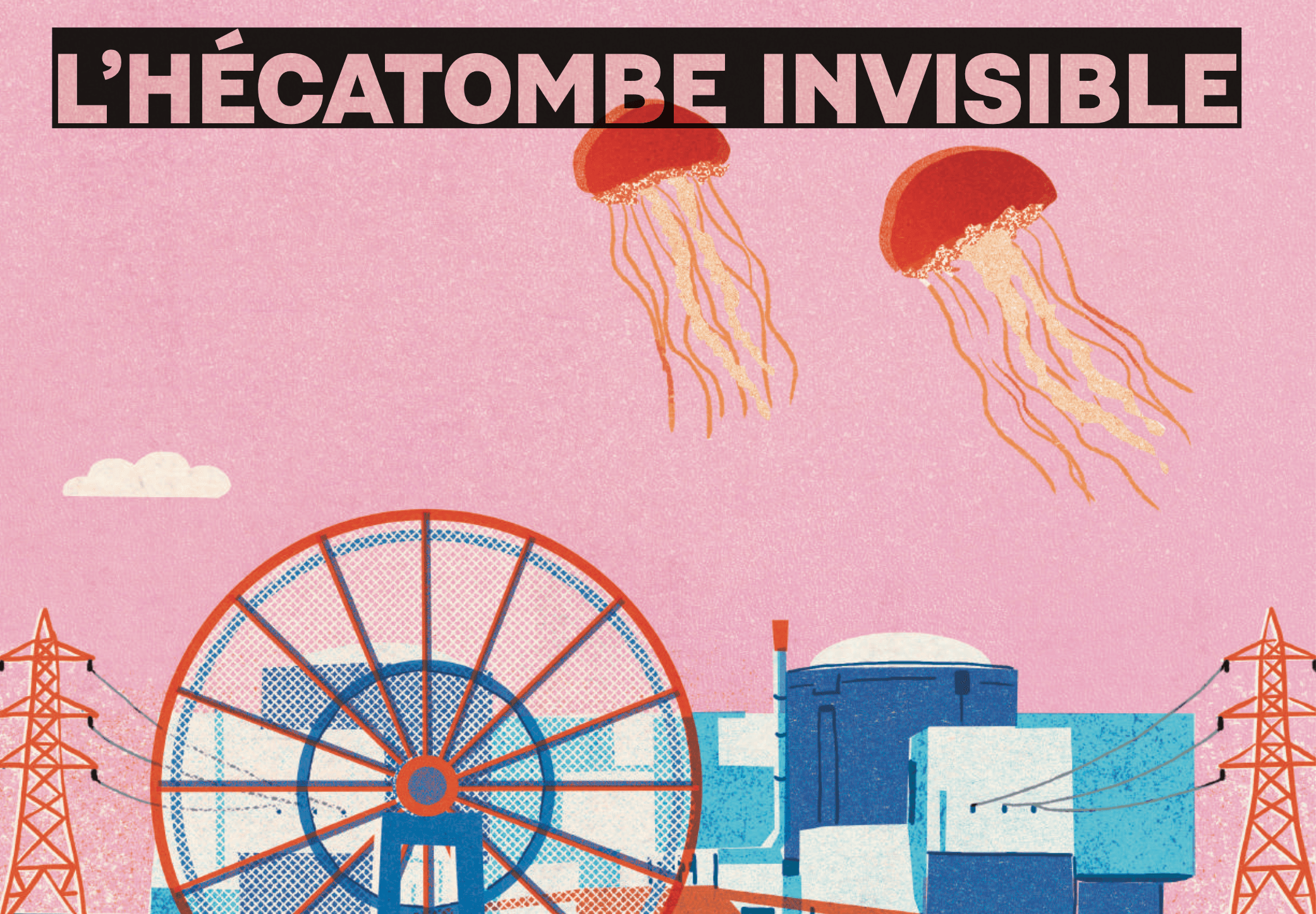
In France and around the world, nuclear power stations are regularly forced to shut down following the invasion of ‘clogging organisms’ into the cooling water intake – the source of water needed to cool the reactor. When non-human animals (jellyfish, fish and crustaceans), or plants pass near the water intake, the filter drum [which prevents large particles from entering the plant’s tertiary cooling circuit] quickly becomes clogged. The operator is forced to shut down the reactor or reduce its power output.
To cool the reactor, every nuclear power station pumps a significant amount of water. For open-loop plants, this amount of water is equivalent to roughly one Olympic-sized swimming pool per minute. Water intakes located in rivers or oceans suck up water at high speed, along with all the life within it. Non-human animals find themselves trapped and may die from sudden impacts, suffocation in the open air, changes in temperature or pressure, as well as treatment with bleach.
When the nuclear programme was launched in France in the 1970s and 1980s, the phenomena of trapping and entrainment were regarded as a major environmental impact. Trapping affects organisms larger than 3 mm, which become trapped on the screen of the filter drum. Entrapment affects juveniles smaller than 3 mm; eggs and larvae passing through the mesh of the filter drum are carried through the entire cooling circuit of the power station and subjected to impact, pressure surges and a rise in temperature of 15°C before being discharged back into the water.
Follow-up measures have been put in place within R&D [i.e. EDF’s Research and Development Department] in order to quantify the impact of entrapment on fish and crustacean populations, particularly at the Blayais power station. “This research was discontinued in 1994 due to a lack of demand from the administration.”
The “Sortir du nucléaire” network has sought to find out what is happening beneath the area of the power stations. Studies, though few in number and incomplete, show that the impact of the power stations on aquatic wildlife is significant. Billions of living creatures are sacrificed every year by the power stations operating in silence to generate so-called green electricity by a company that claims to be committed to nature.
The French Nuclear Safety and Radiation Protection Authority is authorising this massacre without requiring any preventive measures or even monitoring of aquatic wildlife mortality at French power stations, even though some of the species affected are critically endangered.
Estimates for future EPR2 reactors are based on studies that are incomplete and unrepresentative of reality. It is urgent to demand measures to protect aquatic wildlife from EDF and the Nuclear Safety and Radiation Protection Authority. Solutions exist to limit deaths.
Let us demand a genuine commitment from the French nuclear industry to the preservation of biodiversity.
See ful Report in French Language
The ‘Sortir du nucléaire’ network advocates for a harmonious world where the needs of the population are met whilst respecting all living things and the environment. Our federation supports a sustainable energy model based on moderation, efficiency and local community-led energy. The Network thus seeks to fulfil several objectives:
* To bring a unifying message into the public sphere to inform and raise awareness about civil and military nuclear power and to denounce it.
* To support and amplify the actions of all anti-nuclear campaigners in all public spaces and in every possible form.
* To advocate for an energy policy based on community-led, sustainable and viable energy sources.
* To break down barriers within the movement and strengthen links with campaigns sharing similar values.
The ‘Sortir du nucléaire’ network embodies a democratic, free, joyful
and peaceful society where all lives are of equal value.